
Environment
We design and implement all phases of the mining project with respect for the environment and by minimising harmful impacts.
We use the best available technologies in our operations, monitor biodiversity, and ensure the protection of water bodies and soil. Our goal is that the area’s ecosystem remains viable even after the project has ended.
Groundwater and Surface Water
Historic mining activities have had a significant impact on the groundwater in the Outokumpu area. This impact originated at a time when modern knowledge and technologies related to water protection were not yet available.
The Hautalampi mining permit area contains the old tailings areas Sumppi and Keretti, which were part of the closed Keretti mine.
Seepage waters from the newer tailings area (Keretti) flow through a wetland treatment system completed in 2001 into the Lower Hautalampi, which functions as a settling pond. From there, the waters join the bypass channel built in 1995 that carries flows from Suu-Särki. The combined waters then flow via the Ruutunjoki River into Lake Sysmäjärvi.
In connection with the Hautalampi mining project, the aim is to achieve positive impact on the groundwater and surface water flowing from the area. These positive effects will be achieved by removing existing loading factors in the area and by directing additional
Old Sumppi tailings area
The Sumppi area still contains significant quantities of valuable metals that were originally mined from the Keretti mine. Studies have shown that metals leach from the tailings area into the groundwater.
The planned reprocessing of these metal-bearing tailings would improve the quality of groundwater in the area in the future.
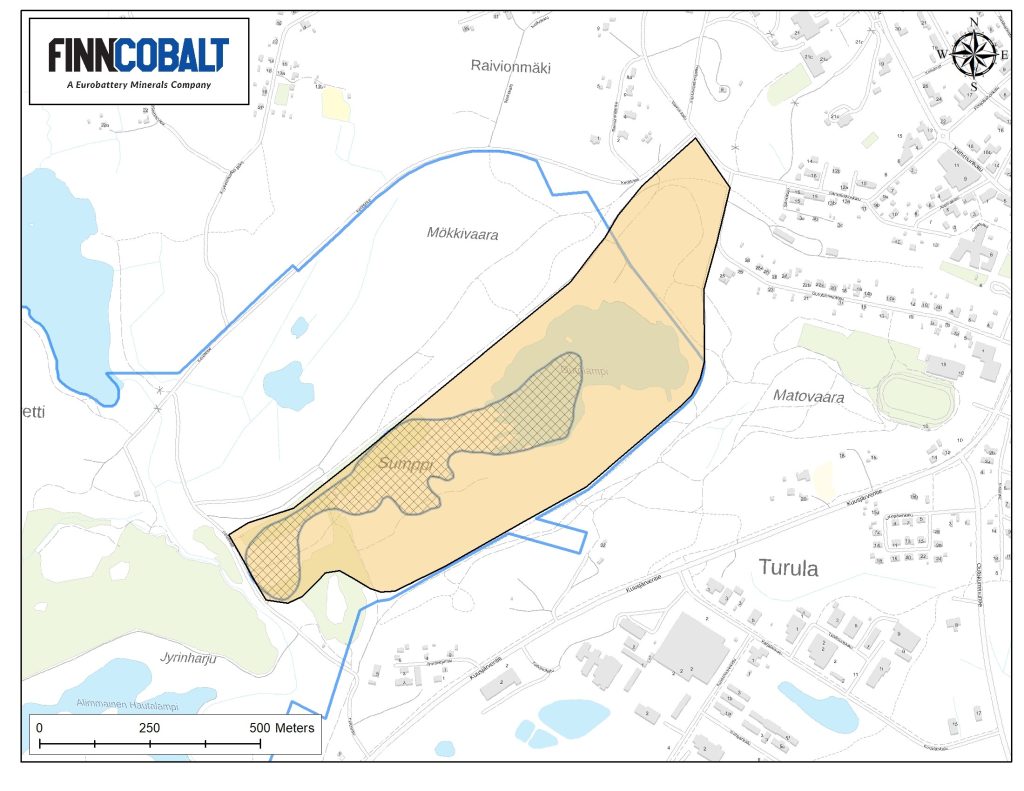
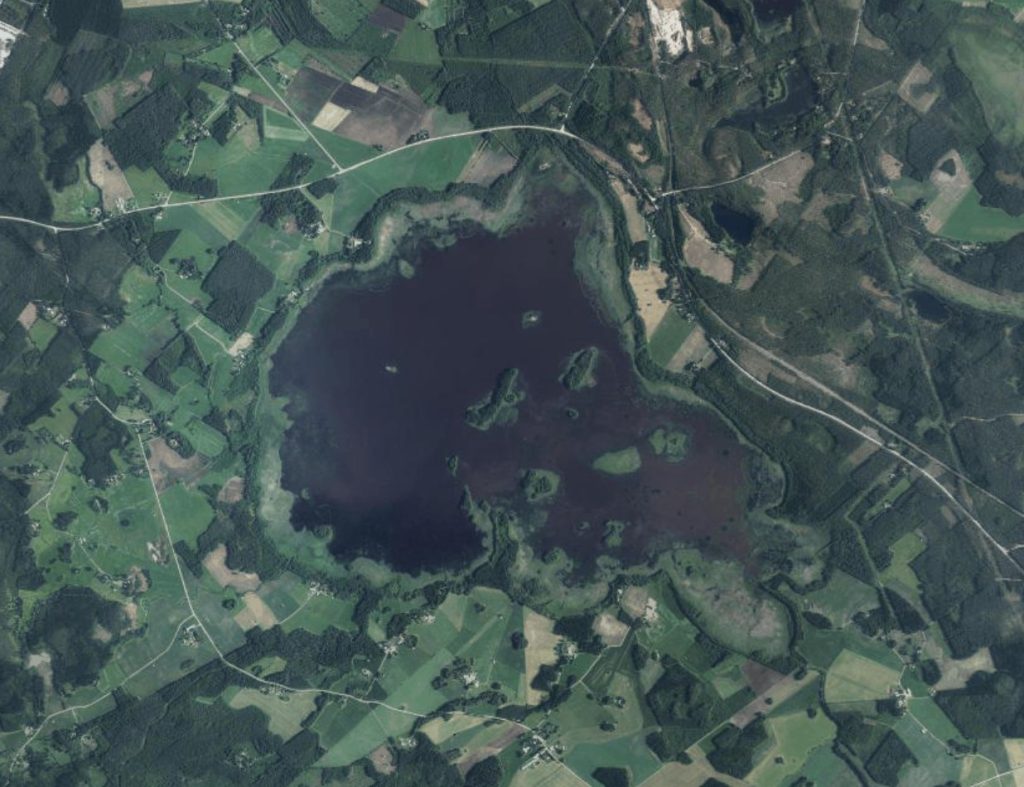
Map 1. Old Sumppi tailings area.
Monitoring commissioned by FinnCobalt Oy
FinnCobalt conducts groundwater sampling four times a year at 12 locations within the mining permit area. In addition, samples are taken from groundwater monitoring wells located in the area between Hautalampi and Sysmäjärvi. Surface water sampling is carried out at four locations within the mining concession area, as well as from the Ruutunjoki River.
Groundwater and surface water samples are analysed for parameters including pH, electrical conductivity, and metal concentrations. In addition, the flow rate of water in the Ruutunjoki River is monitored. Sampling and reporting are conducted by Savo-Karjalan Ympäristötutkimus Oy.
The results of groundwater and surface water monitoring at Hautalampi are published in the form of an annual report. Explore the results here.
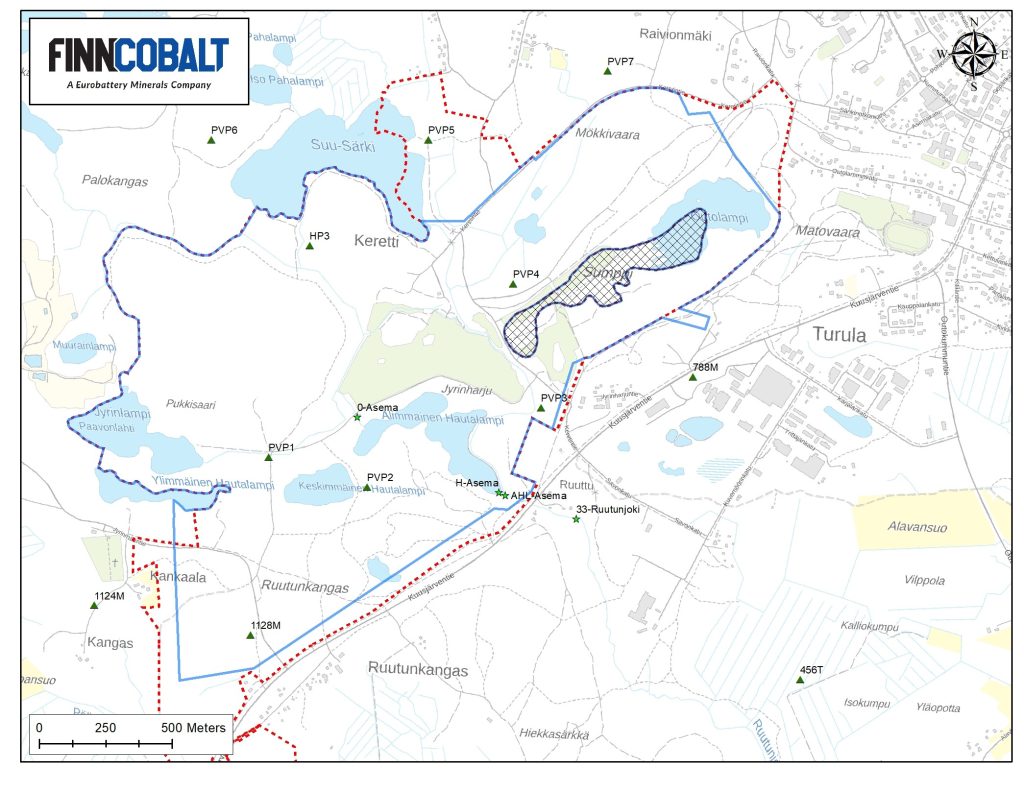
Map 2. Triangles indicate groundwater monitoring well sampling points and stars indicate surface water sampling points. The mining concession area is outlined with a blue line, and the company-owned property is marked with a red dashed line.
Reutilization of tailings
FinnCobalt has carried out extensive soil sample campaign in the old Keretti tailings area and Sumppi tailings area and has found that they still contain valuable raw materials for use in the electrifying industry.
We have initiated research collaborations with various EU-funded programs (BatCircle, Enicon) to explore the potential for reusing old tailings. Although the technology is still under development, we hope that nature, local communities, and groundwater will benefit from it in the near future.
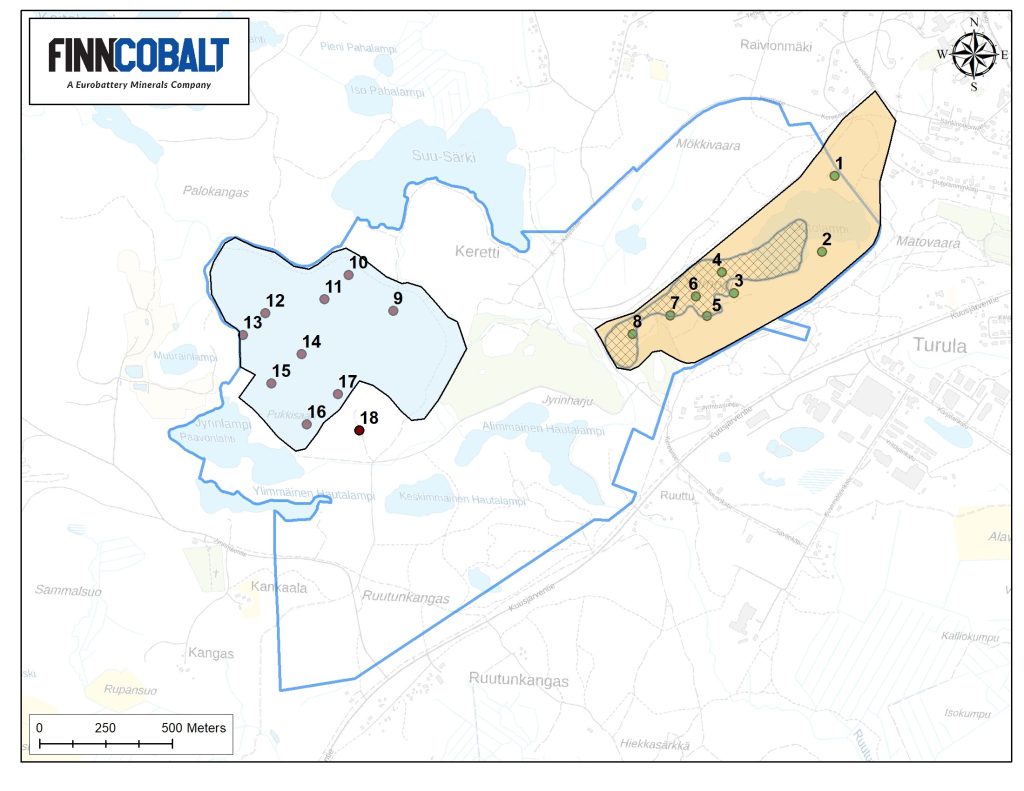
Map 3. Keretti tailings area (blue) and Sumppi tailings area (yellow).
Mine backfilling
The use of tailings in hardening mine backfill is a well-known and widely used technique dating back to the 1950s. It has been scientifically proven to be an effective method for encapsulating tailings and reducing environmental impact.
FinnCobalt has initiated research aimed at finding the safest possible way to encapsulate tailings in a new mine through the use of backfilling.
Mökkivaaran sivukivikasa
During the operation of the Keretti mine, thousands of tonnes of waste rock were extracted, some of which still remain on the slopes of Mökkivaara. According to studies conducted by FinnCobalt, this waste rock pile contains significant amounts of both copper and cobalt.
We have conducted a sampling campaign to further investigate the potential reprocessing of Mökkivaara’s waste rock as well as its use in mine backfilling.
Currently, elements are leaching from the waste rock and flow into Outolampi and from there into the groundwater. By removing this load, we aim to achieve positive environmental impacts in the area.

Carbon Footprint
Nowadays, it is possible to conduct mining operations with a minimal carbon footprint, for example, by replacing heavy diesel machinery with electric equipment powered by carbon-free energy.
Traditionally, hardening mine backfill uses cement, which has long been recognised worldwide as a significant source of CO₂ emissions. Today, however, methods exist that allow cement to be produced carbon-free.
FinnCobalt, together with Outokumpu Mining Hub and VTT Technical Research Centre of Finland, has launched a collaborative project investigating carbon capture in mine backfill. Exploring these possibilities supports our environmentally conscious values, and we look forward to the results.
Nature Surveys
Assessing the current state of the environment is an important part of planning a new mining project. Thanks to studies conducted by FinnCobalt, we now know more than ever about the natural environment surrounding the Hautalampi deposit and the area between Hautalampi and Sysmäjärvi.
The nature around the Hautalampi deposit has been studied as part of the Environmental Impact Assessment (EIA) and more comprehensively in connection with the environmental permit application. In addition, an updated Natura assessment for Sysmäjärvi was conducted in 2025.
These surveys have revealed that the Upper, Middle, and Lower Hautalampi ponds within the mining concession area are home to moor frogs, and that a protected summer lady’s-slipper orchid grows at the southern end of the golf course.
Based on these surveys, we are able to optimize our operations to ensure that these valuable and rare species continue to thrive in the area.


FinnCobalt on Eurobattery Mineralsin tytäryhtiö.